
DIY Guide to Air Filter Replacement
Replacing an HVAC air filter takes only a few minutes, but using the right size, airflow direction, and MERV rating matters. This guide shows Riverside homeowners how to replace a filter correctly, how often to check it, where filters are commonly located, and how a clogged filter can affect airflow, cooling, heating, and energy use.
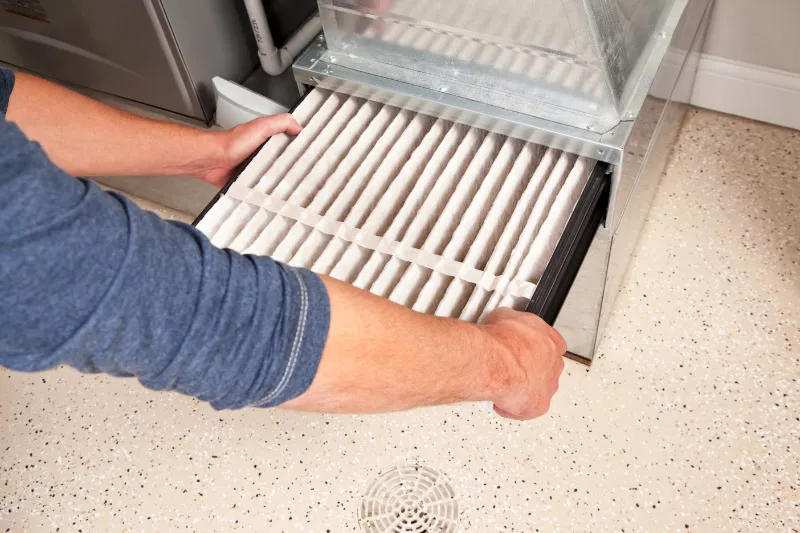
Air filter replacement takes five minutes: turn the system off, find the filter, read the size on the frame, slide in a new one with the arrow pointing toward the equipment, and turn it back on. Magnolia Heating, Cooling & Plumbing says a clogged filter is the most common cause of its service calls, so this job is worth learning.
How Do You Replace an Air Filter Step by Step?
Five steps, in this order:
- Turn the system off at the thermostat so the blower doesn't pull dust into the cabinet while the filter is out.
- Find the filter. It sits in a return grille on a wall or ceiling, or in a slot where the return duct meets the furnace or air handler.
- Pull the old filter out and read the size printed on its frame, such as 20x25x1. Note which way the arrow on the old filter points before you toss it.
- Slide the new filter in with its arrow pointing toward the furnace or air handler, in the direction the air moves. On a ceiling or wall grille, that means the arrow points into the duct, away from the room.
- Close the grille or cover, turn the system back on, and write the date on the new filter's edge.
That's the whole job. The questions below cover the parts that trip people up.
Where Is the Air Filter in a Riverside Home?
In one of three places, and sometimes more than one. Riverside homes mostly run ducted central systems, and the filter can live:
- In a large return grille in a hallway ceiling or wall. Two latches or thumb screws hold the grille; it swings down on a hinge. Check here first.
- In a filter slot on the furnace or air handler, in the garage, a hall closet, or the attic. Look for a one-inch slot with a metal cover where the big return duct enters the cabinet.
- Inside a rooftop package unit, behind an access panel, on some homes and additions. That one's a ladder job, and a fair one to hand to a technician during maintenance.
If your home has two systems, it has two filters. If a system has both a grille filter and a cabinet filter, use one and leave the other slot empty; two filters in series starve the blower of air.
What Size and Which Way Does the Arrow Point?
Buy the size printed on the frame, and point the arrow toward the blower. The nominal size (20x25x1) is what you shop for, even though the actual filter measures about half an inch smaller. If the frame is unreadable, measure the old filter itself and round up to the nearest standard size; a filter that measures 19.5 by 24.5 inches is a 20x25. A filter that rattles or leaves a gap lets dust bypass it, which defeats the purpose.
The arrow marks airflow direction. Air moves from the room, through the return grille and duct, into the furnace, and out the supply vents. So the arrow always points away from the room and toward the equipment. Backwards doesn't break anything, but the filter's pleats collapse sooner and it loads up faster.
What MERV Rating Should You Buy?
The highest rating your system is designed to handle, which for most homes means MERV 8 to 11 in a one-inch slot and MERV 13 in a thicker media filter. MERV, short for minimum efficiency reporting value, measures how well a filter captures particles between 0.3 and 10 microns, and the EPA suggests at least MERV 13 "or as high a rating as your system fan and filter slot can accommodate," with a technician's help if you're unsure.
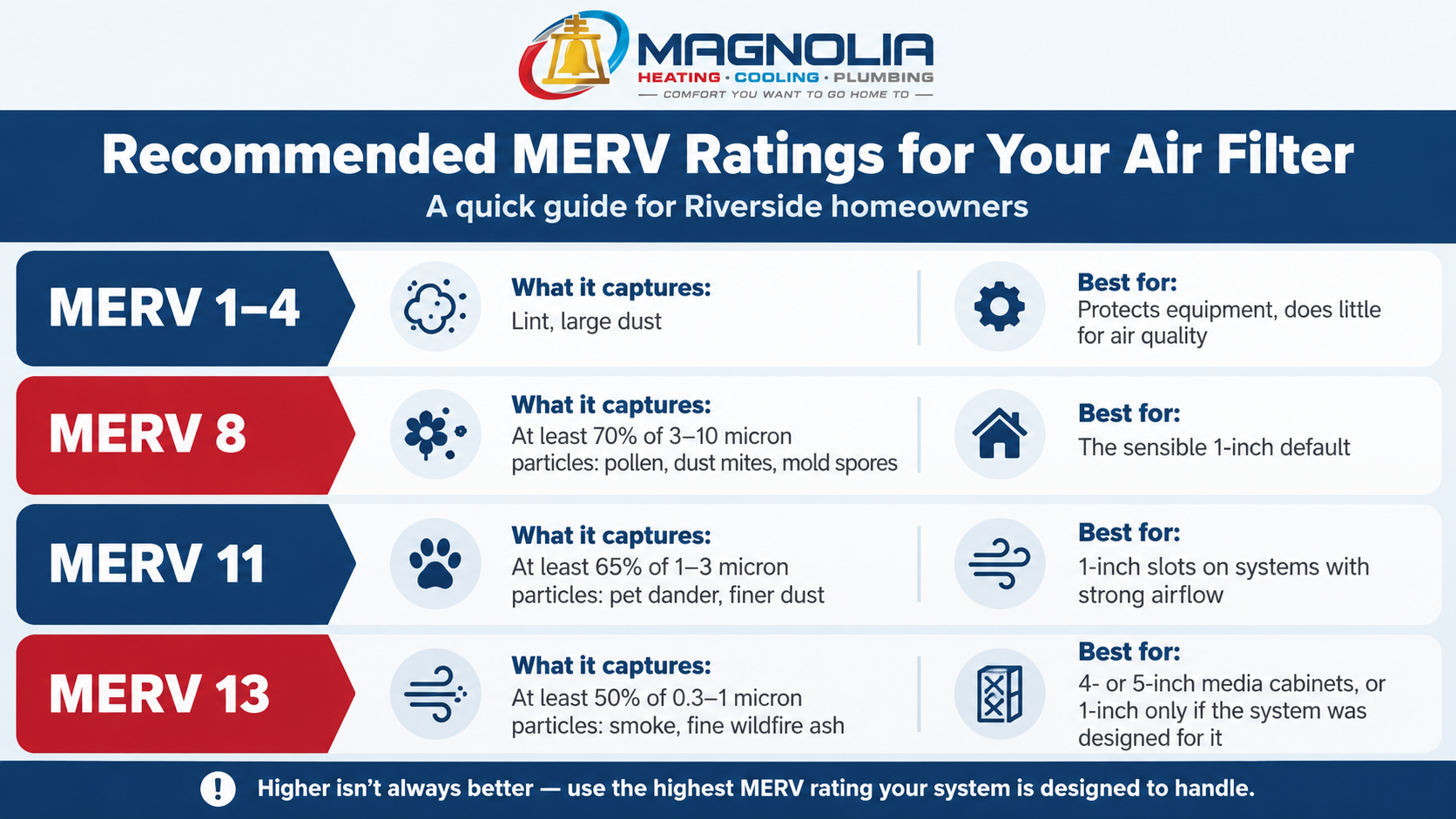
Higher isn't automatically better. A dense filter in a one-inch slot restricts airflow, and the system works harder and can shorten its own life. Magnolia's air filter page puts it plainly: the right answer is the highest rating your equipment is designed to handle. If you want MERV 13 for smoke season, ask Magnolia whether your system can take a thicker media filter, which gives you the rating with far less airflow penalty.
How Often Is Air Filter Replacement Needed in Riverside?
Check it every month and change a one-inch filter every one to three months. The one-to-three-month figure is from Magnolia's site; ENERGY STAR and the Department of Energy both say to check filters monthly and clean or change them as needed. Riverside pushes you toward the short end of that range:
- Summer: the system runs for hours every day from June through September, so a filter loads in four to six weeks.
- Santa Ana wind season: a few windy days can coat a filter with fine dust. Check it after a wind event.
- Pets: a shedding dog or two cats means monthly. Magnolia's maintenance tips for pet owners explain why.
- Wildfire smoke: change it as soon as the air clears.
- Thick media filters (four to five inches) last six months to a year.
Hold the filter up to a light. If you can't see light through it, it's done. Magnolia's post on whether AC filters are recyclable covers what to do with the old one; either way, buy a few at a time and keep them by the grille.
What Happens If You Don't Change the Filter?
The system slowly suffocates. A clogged filter cuts airflow across the indoor coil, so in summer the coil gets too cold and ices over, and in winter the furnace overheats and trips its limit switch. Both show up as weak air at the vents, longer run times and a higher bill, and both end in a service call that a new filter would have prevented. Dust that gets past a collapsed filter lands on the blower and coil, which is a cleaning job for a technician rather than a swap at the grille.
Frequently Asked Questions
Can I run the air conditioner without a filter?
Only long enough to pick up a new one. Without a filter, dust coats the indoor coil and blower within weeks, and that cleaning costs far more than a filter.
Which way does the arrow go on a ceiling filter?
Up, into the duct. The arrow points in the direction air moves, and air moves from the room into the return. For a wall grille, the arrow points into the wall.
Are washable filters a good idea?
They can be, if you wash and dry them fully every month. A damp washable filter grows mold, and most capture less than a MERV 8 pleated filter. For allergies, a pleated filter changed on schedule usually wins.
Does a new filter help with allergies?
A MERV 11 or 13 filter changed on time captures most pollen and dander on each pass. It won't fix air that is picking up dust from leaky ducts downstream of the filter, which is a duct and maintenance question.
Do I need a different filter for the furnace and the air conditioner?
No. In a ducted home the furnace or air handler and the air conditioner share one blower and one filter. The same filter works year-round.
Need Help Choosing the Right Filter?
Magnolia Heating, Cooling & Plumbing can help you pick the right filter for your system, tell you whether it can handle a higher rating, and check the filter at every Maintenance Membership visit. Contact Magnolia online or call (951) 688-3524.
Save on Your Next Home Service
Keeping your home comfortable and running smoothly shouldn’t have to stretch your budget. Explore current specials from Magnolia Heating, Cooling & Plumbing and save on select heating, cooling, plumbing, and indoor air quality services. Check out our latest offers and schedule your service today.